


How EMDR Therapy Helps Reprocess Traumatic Memories

EMDR (Eye Movement Desensitization and Reprocessing) therapy is a well-researched treatment for post-traumatic stress disorder (PTSD). It has been studied for decades and is recognized by major health organizations as an effective treatment for PTSD.
The 2023 U.S. Department of Veterans Affairs and Department of Defense Clinical Practice Guideline strongly recommends EMDR for the treatment of PTSD, along with Cognitive Processing Therapy (CPT) and Prolonged Exposure (PE).
The World Health Organization also includes EMDR among the psychological treatments recommended for adults with PTSD.
Research has repeatedly found that EMDR can significantly reduce PTSD symptoms.
What researchers are still working to understand is exactly why EMDR works.
We know much more about the effectiveness of EMDR than we do about the precise process taking place in the brain. Several theories may help explain what happens during EMDR, and more than one of them may be involved.
What changes when EMDR works?
EMDR does not erase a memory or make you forget what happened.
Instead, the memory can begin to feel different.
You may still remember the experience clearly, but it may no longer bring the same rush of fear, shame, helplessness, anger, or physical tension. Something that once felt as though it were happening all over again can begin to feel like something that happened then rather than something you are still experiencing now.
You know what happened, but your reaction to the memory changes.
This is what we mean when we talk about reprocessing a traumatic memory.
Why can the past continue to affect you?
Our experiences teach us what to expect.
If you have been hurt, threatened, betrayed, humiliated, abandoned, or overwhelmed, your mind and body learn from that experience. Sometimes those lessons remain active long after the situation has ended.
You may logically know:
I’m safe now.
That person is no longer in my life.
I couldn’t have prevented what happened.
I’m not powerless anymore.
Yet something inside you may still react as though the old danger is present.
That can show up as anxiety, being constantly on guard, shutting down, avoiding certain situations, becoming overwhelmed by reminders, or reacting more strongly than you want to.
That is why knowing something logically does not always change how you feel or react.
What happens during EMDR?
EMDR is an eight-phase therapy that includes learning about your history, preparing you for the work, identifying the experiences that may be contributing to current problems, processing those experiences, and checking how things have changed over time.
During the reprocessing part of EMDR, I ask you to briefly bring part of a troubling experience to mind.
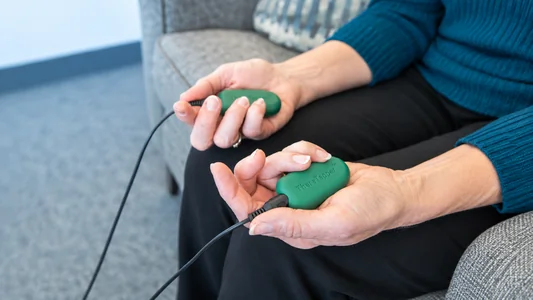
At the same time, I use handheld tappers that gently alternate vibrations between your left and right hands. This is called bilateral stimulation. Other forms of bilateral stimulation can include eye movements or alternating sounds.
You are not expected to tell the entire story over and over. Instead, you notice what comes up—thoughts, feelings, images, memories, or physical sensations—as we move through short sets of bilateral stimulation.
Over time, the experience may begin to shift.
A memory that originally brought intense fear may become less upsetting. A belief such as “I’m not safe” or “It was my fault” may begin to give way to a more accurate understanding based on what you know now.
EMDR helps reprocess traumatic memories so they can be experienced differently in the present.
But how does that happen?
Researchers have several possible explanations.
Theory 1: Your attention is divided between the memory and the present
One of the leading explanations involves something called dual attention.
During EMDR, part of your attention is on the troubling memory while another part is responding to something happening right now—in my practice, the alternating vibrations of the tappers in your hands.
This means you are remembering the past while at the same time remaining connected with the present.
That combination is an important part of EMDR processing.
Instead of becoming completely absorbed in the memory, your brain is doing two things at once: remembering the experience and responding to information coming in from the present.
Researchers are continuing to study exactly how dual attention contributes to EMDR’s effects. One leading explanation is that dividing attention places competing demands on working memory, which may help reduce the vividness or emotional intensity of the memory while it is being processed.
Theory 2: The brain has only so much attention available at one time
A related explanation involves working memory—the limited amount of information your mind can focus on and work with at one time.
Imagine trying to remember a complicated phone number while someone is asking you a question. Doing both at once is harder because each task uses some of your available attention. Researchers believe something similar happens during EMDR.
Bringing a distressing memory to mind requires mental resources. Paying attention to another stimulus at the same time also requires attention. Researchers believe this competition may change the way the memory is experienced while you are thinking about it.
Many studies using eye movements have found that doing a second task while remembering something upsetting can reduce the vividness or emotional intensity of the memory.
A 2026 study found that alternating vibrations affected the emotional response people had while recalling negative personal memories. The researchers found that the more distracting participants found the vibrations, the greater the reduction in emotional intensity. This is an emerging area of research, and more study is needed to understand precisely how tactile bilateral stimulation contributes to EMDR.
Theory 3: Old information can be updated with what you know now
Another way of understanding EMDR comes from the Adaptive Information Processing model, the framework on which EMDR therapy was developed.
In simple terms, difficult experiences can sometimes remain connected with the thoughts, emotions, physical sensations, and beliefs that made sense at the time.
Imagine a child who experiences something frightening and concludes:
I’m powerless.
Years later, that person may be a capable adult with choices, resources, and control over her life. She knows she is no longer powerless.
But certain situations may still trigger the old reaction.
During EMDR, the earlier experience is brought to mind while the person also has access to everything she knows and has learned since then.
The old experience doesn’t disappear. Instead, new information can become connected with it.
I survived.
I have choices now.
I can protect myself.
What happened was not my fault.
I’m safe now.
That is one way to understand memory updating or reprocessing: the past remains part of your story, but it no longer has to carry the same meaning or produce the same automatic response.
Theory 4: Your brain may learn that an old danger is no longer a current danger
Our brains constantly use past experiences to anticipate what might happen next.
Usually, this is useful. If something was dangerous before, remembering that danger can help protect us.
But sometimes the brain continues responding to an old threat even when circumstances have changed.
A person who has experienced trauma may find that certain sounds, situations, expressions, places, or relationship dynamics trigger an automatic sense of danger.
Another theory about EMDR is that processing the memory while experiencing the present may help the brain recognize: That happened then. This is happening now. They are not the same. After processing, the old expectation of danger can become less powerful.
This may help explain why reminders of the memory no longer trigger the same emotional or physical reactions.
So which explanation for EMDR is correct?
We don’t know yet.
Working memory, divided attention, changes in emotional arousal, and the brain’s ability to update information based on present circumstances may all contribute to what happens during EMDR.
Research into exactly how EMDR works is still developing. A 2024 State of the Science review of EMDR research describes substantial evidence that EMDR is effective for PTSD while also reviewing several theories about how the processing may work. Working-memory research currently provides one of the stronger explanations, but researchers are continuing to study the biological and psychological processes involved.
As neuroscience and research methods continue to advance, we are likely to learn more about what happens as a troubling memory becomes less emotionally intense and is experienced differently.
It is also important to remember that EMDR is more than bilateral stimulation. The eight-phase therapeutic process includes preparation, identifying the experiences connected with current problems, processing those experiences, and evaluating what has changed.
What we can say with much more confidence is this:
EMDR is an effective treatment for PTSD, even though science has not yet identified one complete explanation for why it works.
That is not unusual. Treatments can have strong evidence showing that they help people before researchers fully understand every process responsible for the change.
What can EMDR help change?
When EMDR is successful, people may notice that experiences from the past simply do not affect them in the same way.
You may be able to think about what happened without becoming overwhelmed.
A reminder that once triggered intense anxiety may lose much of its power.
You may find yourself responding differently in situations that once brought up fear, anger, shame, or the urge to shut down.
And something you have understood intellectually for years may finally begin to feel true.
The goal isn’t to erase your past. It’s to help the past stop controlling your present.
EMDR Therapy in Fort Myers
You may already understand why you react the way you do. You may recognize the pattern and know what you would like to do differently—yet still find yourself having the same emotional or physical reaction when something triggers it.
That is often where EMDR can be helpful.
I am Rachele Epp, LMHC, an EMDR Certified Therapist™ with more than 30 years of counseling experience. I provide EMDR therapy for adults in my Fort Myers office and online throughout Florida.
We will work at a pace that takes your history, current needs, and readiness for treatment into account. If past experiences are contributing to anxiety, strong emotional reactions, or patterns that keep repeating, we can talk about whether EMDR may be a good fit for you.
Contact Epp Counseling to request a free 15-minute consultation.